








SUMMARY
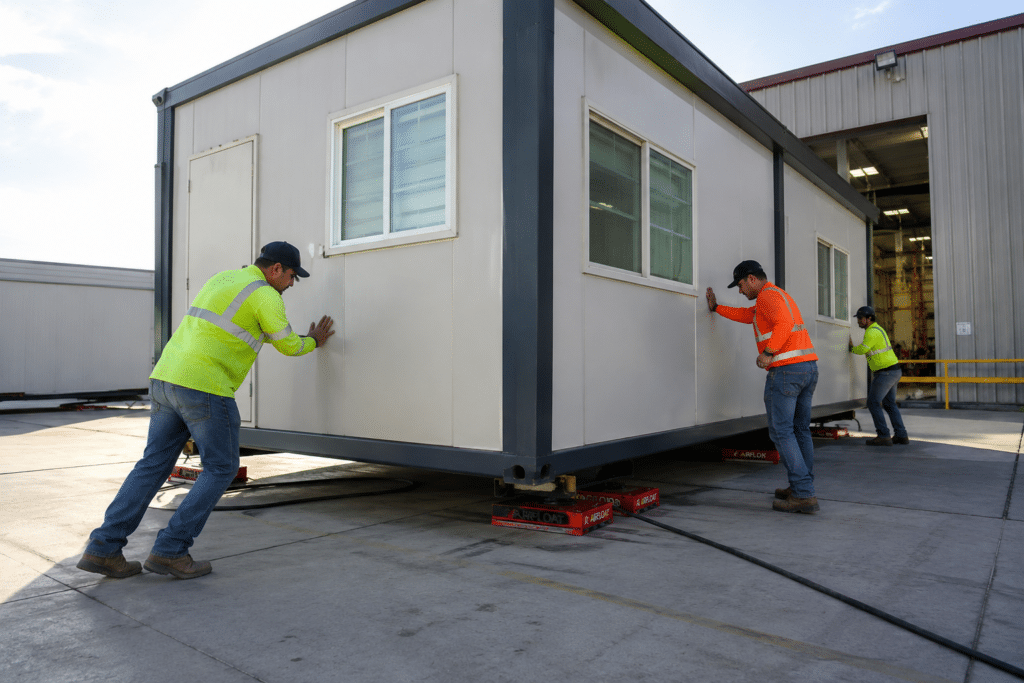
A manufacturer of prefabricated modular buildings — including visitor centers, restrooms, and other park facilities — uses air skids throughout their production line. Built primarily from concrete with internal plumbing, paneling, insulation, roofing, and interior features, these buildings are constructed at a central facility, shipped to their destinations, and dropped into state and national parks ready to use. You’ve likely seen them on a trail or at a trailhead.
Estimated cost savings vs. powered systems
Estimated increase in production velocity
Working reference weight per unit
THE PROBLEM
- Units weigh 15,000–35,000 lb, straining crane capacity
- Cranes slowed throughput due to clearance and scheduling
- In-ground conveyance systems were cost-prohibitive
- Forklifts ruled out for safety and cost reasons
- Steel casters risked damaging polished concrete floors
THE SOLUTION
- Air skids support full build-out: frame, walls, and interiors
- Continuous production flow without crane-related delays
- Units can be moved by hand — no powered tuggers needed
- Tighter spacing between stations maximizes floor footprint
- No floor damage; skids store flat when not in use
Safety Improvements
The air skid system addresses several of the most common injury and damage risks in heavy module manufacturing.
No powered equipment needed
Units float on a thin film of air and can be guided by hand — eliminating the need for forklifts or powered tuggers and reducing the risk of operator error with heavy machinery.
No floor damage
Steel casters can crack or gouge polished concrete under heavy loads. Air skids distribute weight evenly across a large footprint, protecting the floor throughout the production cycle.
Locked down when off
When the air supply is cut, skids settle directly onto the concrete. There is no accidental movement possible with the system powered down — the load stays exactly where it is.
Dead-man pendant control
A quick-exhaust valve rapidly vents air when the pendant is released, settling the load in about one second — giving operators immediate, reliable emergency stop capability at all times.
IMPLEMENTATION AND RESULTS
50%+ cost savings. Estimated reduction in movement-related costs compared to a powered forklift or tugger system.
30% throughput increase. Estimated improvement in production velocity by eliminating crane-related delays and enabling continuous flow.
Better space utilization. Units can be staged closer together between assembly stations, fitting more production in the same facility footprint.
No floor damage. Air skids protect polished concrete that steel casters would scratch or crack under load.
Hand-movable loads. Operators can guide floating units by hand — no specialized equipment or licensing required.
For more information about our air skid systems, contact us today.


