













Air Supply for Air Skid Systems
Your Questions Answered
June 10, 2026
Share:
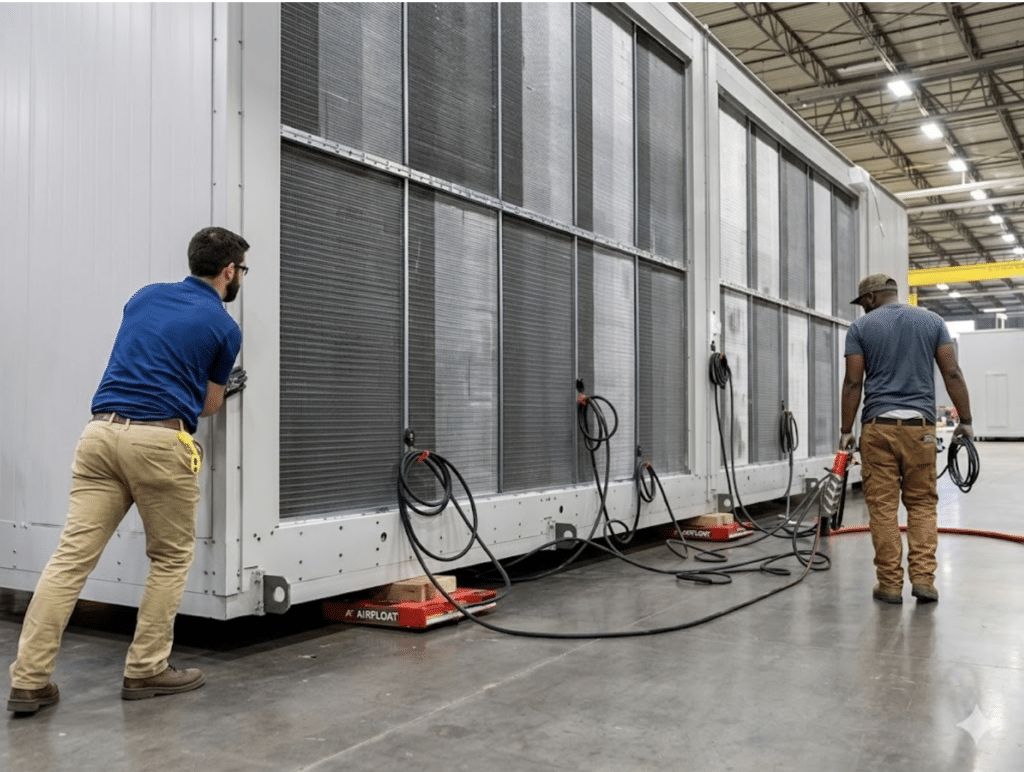
If you’re considering air skids for your next heavy equipment move, one of the first things you’ll want to consider is your air supply. The good news? For most facilities, the air system you already have will likely do the job. Here’s everything you need to know.
Do I Have a Big Enough Compressor?
This is the number one question customers ask and the answer is almost always yes. Most manufacturing facilities with installed air systems already have more than enough capacity to run air skid equipment.
To confirm your setup will work, check your quote. The quote specifies exactly how much airflow (in SCFM) and pressure (in PSI) your system needs. If you want more detail, review the Air Skid Compressor Sizing Guide to view the recommended compressor size for each size of Air Skid.
Air Skid Compressor Sizing Guide
Get the right compressor for your application. Download the guide.
What Is CFM and Why Does It Matter?
You’ll see two key numbers when it comes to air supply:
- SCFM (Standard Cubic Feet per Minute) — how much air is flowing through the system. You’ll often hear this shortened to CFM in conversation.
- PSI (Pounds per Square Inch) — the pressure at which the air is delivered.
Think of it this way: a leaf blower has high CFM (lots of flow) but low PSI (not much pressure). A scuba tank is the opposite, high pressure, but low flow. Air skid systems need a healthy balance of both.
We recommend 80 PSI at the air supply or air drop, and most facility air systems run at 90–120 PSI. Our air bearings don’t use “high-pressure” air—just standard, everyday compressed air.
How Does Floor Condition Affect Air Usage?
Floor condition has a major impact on how much air your system needs. Smoother surfaces require significantly less airflow. To put it in concrete terms: a 12-inch air skid on a poor concrete floor (rough, aged, or textured) may require about 13.5 CFM. That same skid on a smooth epoxy floor needs only about 6.75 CFM—roughly half the air. Review our High Performance Air Bearing Chart for specifications on your air bearing size and floor condition.
The floor quality spectrum, from best to worst air efficiency:
- Smooth steel
- Epoxy-coated concrete
- Polished or sealed concrete
- Machine-trowel finished concrete (unsealed)
- Worn, rough, or porous concrete (highest air usage)
Note: Air skid systems are not designed for brushed concrete, asphalt, or gravel surfaces.
What Size Supply Hose Do I Need?
We supply the air skids, controller, and the hoses connecting each skid to the controller. The supply hose is the one running from your air drop or compressor to our system. This is typically provided by the customer, since hose length needs vary widely.
As a general guide, hose diameter scales with airflow requirements and run distance:
- Small systems (~50 SCFM): 1/2 inch hose
- Large systems (~300 SCFM at 150 ft): 1-1/4 inch hose
- Very large systems or long runs (500+ ft): 1-1/2 to 2 inch hose
We have a Hose Flow & Sizing Guide to help you size this correctly. We can also supply the hose upon request.
Hose Flow & Sizing Guide
Get the right supply hose for your skids. Download the guide.
What Type of Compressor Should I Use?
The right compressor type depends on your situation:
- Permanent installation for multiple moves: Electric rotary screw compressor
- Temporary installation for a one-time move: Towable diesel rotary screw compressor (available at equipment rental companies like Sunbelt)
We don’t sell or rent compressors, but we’ll give you the exact specs so an air compressor expert can provide the correct size for your needs.
Should I Use an Accumulator Tank?
An accumulator tank acts as a buffer between your compressor and the air skid system. These tanks are used when your compressor is borderline-sized or if other tools are drawing from the same air supply at the same time.
If this applies to your situation, talk to your air compressor supplier. They can recommend the right tank size based on your overall demand.
What About Air Quality?
For best performance, we recommend clean, dry air. Air skid systems are quite robust, but clean, dry air will maximize performance and longevity.
Troubleshooting: When the System Isn’t Floating Right
If your air skid system isn’t performing as expected, the problem is almost always one of two things: floor condition or air supply. Assuming the floor is in decent shape, air is the likely issue.
The most common causes are not an undersized compressor, but rather:
- A supply hose that’s too small for the distance or flow rate
- Controls set too low — simply tuning them up will get the bearings inflated and floating
You’ll know you have enough air when the bearings inflate and the load begins to visibly shift and “levitate.” If one skid is dragging, it’s usually carrying the heaviest portion of the load—adjust that bearing’s controls until it lifts cleanly.
The Bottom Line
Air supply is simpler than it sounds. Most facilities already have what they need. And if you’re unsure, we can tell you exactly how much air you’ll need and which hose size to use—no guesswork required.
Have questions? Give us a call and we’re happy to walk through the requirements with you.
